



What is EcoVadis? A Complete Guide for Businesses
EcoVadis is the world’s most trusted provider of business sustainability ratings, evaluating over 130,000 companies across 200+ industries. It provides an evidence-based platform that assesses ESG (Environmental, Social, and Governance) performance to help businesses manage supply chain risk and improve global impact.
EcoVadis is a global ESG rating platform that evaluates how effectively companies implement sustainability practices across their operations and supply chains. It provides a standardized score (0–100) used by global buyers to assess supplier risk and compliance.
In today’s global supply chains, sustainability is no longer optional—it is a business requirement. One of the most widely used platforms to evaluate corporate sustainability performance is EcoVadis.
This guide explains what EcoVadis is, how the assessment works, and why your score can directly impact revenue, supplier relationships, and market access. Whether you are new to EcoVadis or looking to improve your performance, this blog is designed to be your go-to resource.
What is EcoVadis and Why Does It Matter?
EcoVadis is a global sustainability rating platform that evaluates companies across environmental, social, and ethical criteria. Businesses across industries use assessment to assess suppliers, manage ESG risks, and improve transparency.
The EcoVadis framework is built on international standards such as:
- GRI (Global Reporting Initiative)
- UN Global Compact
- ISO 26000
For businesses, it is not just a rating it is a commercial enabler. Many global companies now require suppliers to maintain a minimum score to remain in their value chain.
In practice, most companies don’t lose points due to poor sustainability performance they lose points due to lack of documentation and structured evidence. Companies that align policies, actions, and reporting typically see faster score improvements.
How the EcoVadis Assessment Works
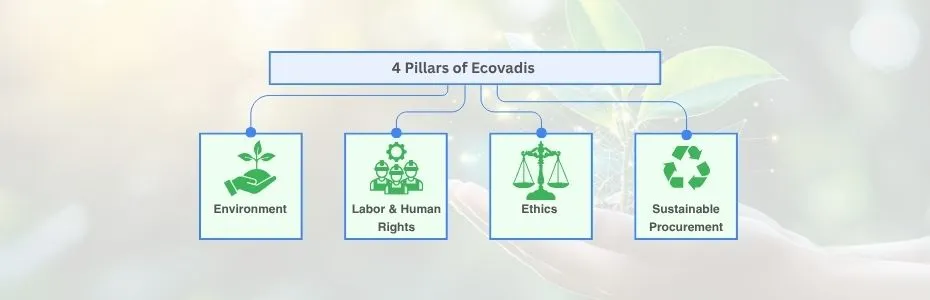
The EcoVadis assessment evaluates companies across four key pillars:
1. Environment
Covers emissions, energy use, waste management, and climate strategy.
2. Labor & Human Rights
Focuses on employee welfare, diversity, and working conditions.
3. Ethics
Includes anti-corruption, business integrity, and compliance systems.
4. Sustainable Procurement
Assesses how companies manage supplier sustainability.
Each company completes a detailed questionnaire and submits supporting documents. EcoVadis analysts then validate the information and assign a score.
EcoVadis Cost and Timeline****Add content:
- Cost varies based on company size (typically €500–€5,000+ annually)
- Timeline:
- Questionnaire: 2–4 weeks
- Evaluation: 6–8 weeks
- Total: ~2–3 months
For more detailed pricing you can refer our blog on ecovadis pricing here.
Understanding the EcoVadis Scorecard
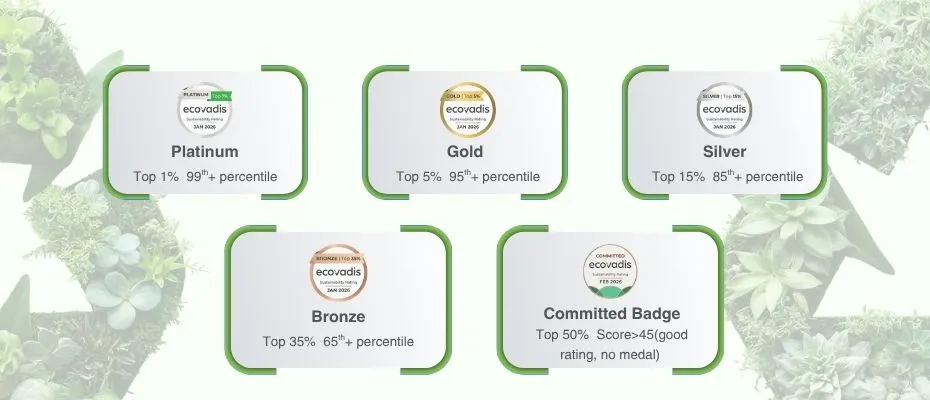
The score ranges from 0 to 100. As of 2026, medals are awarded based on your Percentile Rank compared to all companies in the database.
Important: To qualify for a medal, a company must achieve a minimum score of 30 in each of the four themes (Environment, Labor & Human Rights, Ethics, and Sustainable Procurement).
| Medal | Percentile | Eligibility Requirement |
|---|---|---|
| Platinum | Top 1% | 99th+ percentile |
| Gold | Top 5% | 95th+ percentile |
| Silver | Top 15% | 85th+ percentile |
| Bronze | Top 35% | 65th+ percentile |
| Committed Badge | Top 50% | Score >45 (Good rating, no medal) |
Your scorecard also includes the 360° Watch, an AI-driven monitoring tool that scans over 100,000 sources (NGOs, press, regulators) for negative news. A single major compliance scandal can lower your score regardless of how strong your documentation is.
A good score depends on your industry, but most global buyers expect suppliers to score above 50–60 to remain competitive.
Why EcoVadis is Important for Businesses
1. Supplier Qualification
Many multinational companies require EcoVadis ratings for onboarding.
2. Risk Management
It also helps identify ESG risks across operations and supply chains.
3. Competitive Advantage
A strong score can differentiate your company in tenders.
4. Regulatory Alignment
The questionnaire aligns with global ESG frameworks, supporting compliance.
How EcoVadis Weights Your Submission
It doesn’t just look at what you say; they look at what you do. Their analysts weigh your score based on three layers:
| # | Principle/Title | Description |
|---|---|---|
| 1 | Policies (25%) | Your formal commitments and management goals. |
| 2 | Actions (40%) | Implementation of the policies (e.g., training, equipment, procedures). |
| 3 | Results (35%) | KPIs, reporting, and 360° Watch findings. |
Common Challenges Companies Face in EcoVadis
Despite its benefits, many companies struggle with good score due to:
- Submitting policies without proof of implementation
- Missing KPIs or measurable results
- Uploading outdated or non-relevant documents
- Ignoring supplier sustainability practices
- Not aligning with frameworks like Global Reporting Initiative
These challenges often lead to low scores even when companies are performing well operationally.
The EcoVadis Carbon Action Module (CAM)
As global regulations like the EU’s CSRD and CSDDD take effect, EcoVadis has introduced the Carbon Action Module. This is a separate scorecard specifically for tracking Greenhouse Gas (GHG) emissions.
To achieve high scores in 2026, companies must demonstrate:
- Carbon Footprint Measurement: Reporting Scope 1, 2, and 3 emissions.
- Target Setting: Aligning with Science Based Targets (SBTi).
- Supplier Engagement: How you are helping your own suppliers decarbonize.
How to Improve Your Score
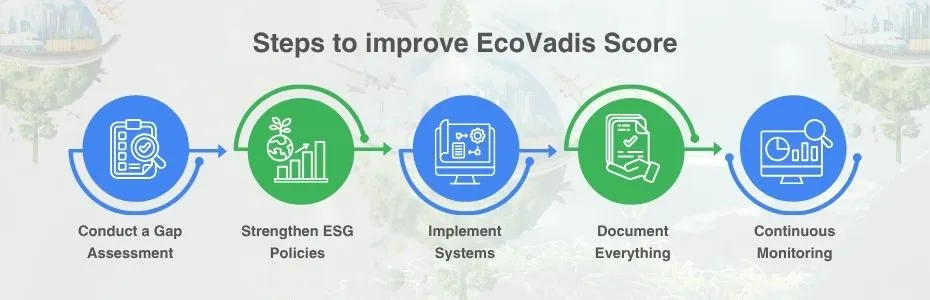
Improving your performance requires a structured approach:
Step 1: Conduct a Gap Assessment
Identify missing policies and documentation.
Step 2: Strengthen ESG Policies
Align policies with global standards.
Step 3: Implement Systems
Ensure policies are actively implemented and tracked.
Step 4: Document Everything
The assessment heavily relies on evidence-based evaluation.
Step 5: Continuous Monitoring
Track performance and update submissions regularly.
Case Study – Improving EcoVadis Performance
A mid-sized manufacturing company improved its score from 42 to 68 within one assessment cycle by:
- Introducing formal ESG policies
- Implementing supplier screening processes
- Strengthening documentation and reporting
This improvement helped the company retain key clients and win new contracts.
EcoVadis vs Other ESG Frameworks
EcoVadis complements not replaces other ESG frameworks. It integrates well with:
- Sustainability reporting
- ESG ratings
- Supplier audits
For businesses, It acts as a practical implementation tool rather than just a disclosure framework.
| Feature | EcoVadis | B-Corp | CDP |
|---|---|---|---|
| Primary Focus | Supplier ESG Performance | Total Social/Legal Impact | Carbon & Climate |
| CSRD Alignment | High (Supports Data Collection) | Medium | High (Climate Specific) |
| Audit Style | Document Validation | Full On-site/Virtual Audit | Disclosure-based |
| Best For | B2B / Procurement | Brand Purpose / Culture | Investors / Carbon Disclosure |
How EcoVadis Impacts Your Business Strategy
This assessment is increasingly influencing:
- Procurement decisions
- Investor perception
- Brand reputation
Companies with strong performance are better positioned for long-term growth.
Final Thoughts: Is EcoVadis Worth It?
This assessment is no longer just a rating platform it is a business-critical metric. Companies that proactively manage their sustainability performance gain a competitive edge in global markets.
If used strategically, it can transform sustainability from a compliance requirement into a value driver.
Sources
Ready to align your sustainability strategy?
Talk to Growlity about building your ESG reporting strategy.