



What is SBTi and Why Are Businesses Racing Toward Science Based Targets?
Climate action is no longer a side conversation in business. Investors are asking for measurable sustainability strategies. Customers want transparency. Global supply chains are becoming more carbon-conscious. Governments are introducing stricter disclosure rules. And in the middle of this shift, one framework has rapidly become the gold standard for corporate climate credibility: SBTi.
The Science Based Targets initiative (SBTi) helps companies set emissions reduction targets that are aligned with climate science and global net-zero goals. Instead of vague sustainability promises, SBTi gives businesses a measurable and accountable path toward reducing greenhouse gas emissions.
Today, thousands of organizations across industries are adopting science-based targets because stakeholders no longer trust generic claims like “eco-friendly” or “carbon conscious.” Businesses are now expected to prove progress with real data, transparent reporting, and validated targets.
If you are trying to understand what SBTi means, why it matters, how it works, and whether your company should adopt it, this guide will help you understand everything in a practical and business-focused way.
What is SBTi?
The Science Based Targets initiative (SBTi) is a global organization that helps companies establish greenhouse gas reduction targets aligned with the latest climate science.
The initiative was created through collaboration between organizations including:
The primary goal of SBTi is to help businesses reduce emissions in line with the Paris Agreement and support the global transition toward a low-carbon economy.
In simple terms, SBTi answers one critical question:
“How much should a company reduce emissions, and by when, to help limit global warming?”
That scientific alignment is what makes SBTi different from traditional sustainability goals.
Why SBTi is Becoming a Business Priority
A few years ago, sustainability reporting was often optional branding. Today, it influences investor decisions, procurement eligibility, customer trust, and regulatory readiness.
Companies are increasingly adopting SBTi because it helps them:
- Build climate credibility
- Strengthen ESG performance
- Improve investor confidence
- Meet supply chain requirements
- Prepare for future regulations
- Reduce operational risks
- Improve brand reputation
- Gain competitive advantage
Many global corporations now require suppliers to establish science-based targets as part of procurement expectations. This means even mid-sized companies are entering the SBTi ecosystem to remain relevant in global supply chains.
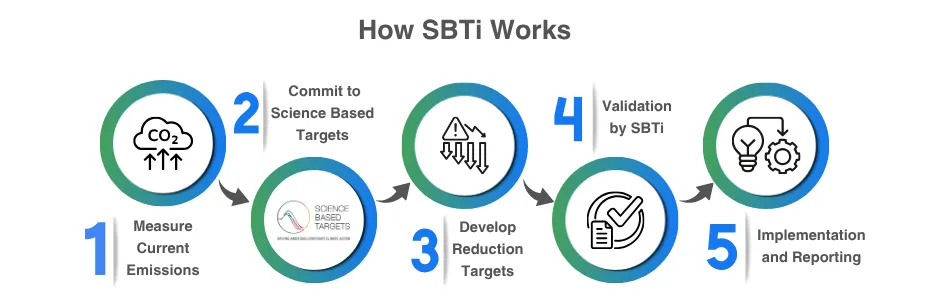
How SBTi Works
The SBTi process is structured but practical. Companies follow a step-by-step approach to establish validated emissions reduction goals.
Step 1: Measure Current Emissions
Businesses first calculate their greenhouse gas emissions across:
- Scope 1 emissions (direct emissions)
- Scope 2 emissions (purchased energy)
- Scope 3 emissions (value chain emissions)
Most organizations discover that Scope 3 emissions form the largest portion of their carbon footprint.
Step 2: Commit to Science Based Targets
Organizations publicly commit to setting science-based targets within a defined timeline.
This signals to stakeholders that the business is serious about climate action rather than making unsupported sustainability claims.
Step 3: Develop Reduction Targets
Companies create emissions reduction targets aligned with scientific methodologies and sector-specific pathways.
These targets may include:
- Near-term reduction targets
- Long-term net-zero targets
- Renewable energy commitments
- Supply chain decarbonization goals
Step 4: Validation by SBTi
The targets are reviewed and validated by SBTi experts to ensure they meet scientific requirements and framework criteria.
This validation step is what gives SBTi credibility in the global sustainability market.
Strategic Tip: Validation can take several months due to high demand. If you are preparing for a specific reporting cycle or a major supply chain tender, we recommend initiating your target setting and data preparation at least 6–9 months in advance.
Step 5: Implementation and Reporting
After validation, businesses begin implementation and disclose progress regularly through sustainability reports, ESG disclosures, or climate reporting frameworks.
Note for Small and Medium Enterprises (SMEs): You don’t always need the full, complex validation process. The SBTi offers a “Streamlined Route for SMEs” that allows smaller businesses to set near-term, science-based targets without the standard, more rigorous validation steps. If you have fewer than 500 employees and aren’t in a high-impact sector, this is often the fastest way to get started.
Understanding Scope 1, Scope 2, and Scope 3 Emissions
One of the biggest reasons businesses struggle with SBTi is confusion around emissions categories.
Scope 1 Emissions
These are direct emissions generated from company-controlled operations.
Examples include:
- Fuel combustion
- Company-owned vehicles
- Manufacturing operations
Scope 2 Emissions
These are indirect emissions from purchased electricity, steam, heating, or cooling.
Electricity usage in offices or factories usually falls under Scope 2.
Scope 3 Emissions
These are indirect emissions across the value chain.
Examples include:
- Supplier emissions
- Business travel
- Logistics
- Product use
- Employee commuting
- Waste disposal
For many organizations, Scope 3 can represent over 70% of total emissions.
Why Scope 3 Emissions Matter So Much
The business world is rapidly moving toward value-chain accountability.
Large corporations are increasingly evaluating suppliers based on carbon performance. This means businesses without emissions data or reduction plans may face:
- Procurement disadvantages
- Reduced partnership opportunities
- ESG rating pressure
- Investor concerns
That is why SBTi adoption is no longer limited to multinational corporations. Even growing businesses are now building carbon strategies to stay competitive.
Key Benefits of Adopting SBTi
Benefits of SBTi for Businesses
1. Stronger ESG Performance
Science-based targets strengthen ESG reporting by adding measurable climate action metrics.
This improves transparency and increases stakeholder confidence.
2. Better Investor Trust
Investors increasingly prefer companies with structured climate strategies.
SBTi validation signals long-term environmental preparedness and governance maturity.
3. Competitive Supply Chain Positioning
Many large enterprises now expect suppliers to demonstrate carbon reduction commitments.
SBTi can improve supplier credibility and procurement opportunities.
4. Operational Efficiency
Carbon reduction often leads to operational improvements such as:
- Energy efficiency
- Resource optimization
- Waste reduction
- Lower utility costs
5. Stronger Brand Reputation
Customers are becoming more sustainability-conscious.
Businesses with verified climate commitments often gain stronger brand trust and differentiation.
Challenges Companies Face During SBTi Adoption
Although SBTi provides significant value, implementation is not always simple.
Some common challenges include:
Data Collection Complexity
Many businesses lack centralized emissions data systems.
Gathering supplier data can also be difficult.
Scope 3 Measurement Difficulties
Scope 3 calculations often require coordination across departments and suppliers.
This can become resource-intensive.
Internal Alignment
SBTi implementation requires collaboration between:
- Sustainability teams
- Procurement
- Operations
- Finance
- Leadership
Without executive support, progress slows down.
Changing Regulations and Frameworks
Climate disclosure frameworks continue evolving globally.
Businesses must stay updated to maintain compliance and reporting accuracy.
Industries Where SBTi is Growing Rapidly
Science-based targets are becoming increasingly important across sectors including:
- Manufacturing
- Construction
- Technology
- Pharmaceuticals
- Retail
- Automotive
- Logistics
- Food and beverage
- Consumer goods
Companies in export-heavy industries are particularly accelerating sustainability programs because global buyers increasingly evaluate climate performance.
Real-World Example of SBTi in Action
Imagine a manufacturing company with high energy usage and global suppliers.
Without a structured climate strategy, the company faces:
- Rising energy costs
- Procurement pressure
- Investor concerns
- ESG reporting gaps
After adopting SBTi, the company:
- Measures emissions
- Identifies high-impact areas
- Reduces energy waste
- Transitions toward renewable energy
- Engages suppliers
- Tracks progress annually
Over time, this improves operational efficiency, sustainability ratings, investor confidence, and market positioning.
This is why SBTi is increasingly viewed not just as an environmental initiative, but as a business resilience strategy.
SBTi and Net Zero: What is the Connection?
SBTi plays a major role in helping companies achieve net-zero emissions responsibly.
A true net-zero strategy focuses on:
- Deep emissions reduction
- Long-term transition planning
- Limited reliance on offsets
- Transparent reporting
This is important because stakeholders are becoming more critical of unsupported net-zero claims.
SBTi helps organizations build climate strategies that are measurable, science-aligned, and credible.
Common Mistakes Businesses Make With SBTi
Many organizations rush into climate commitments without proper planning.
Some common mistakes include:
- Setting unrealistic targets
- Ignoring Scope 3 emissions
- Treating sustainability as only a reporting exercise
- Failing to involve leadership
- Not investing in emissions data systems
- Delaying supplier engagement
The most successful companies approach SBTi as a long-term transformation strategy rather than a short-term certification exercise.
How Businesses Can Prepare for SBTi Successfully
Businesses preparing for SBTi should focus on:
Building Accurate Emissions Data
Reliable carbon accounting is the foundation of science-based targets.
Engaging Leadership Early
Executive buy-in is essential for successful implementation.
Working With Sustainability Experts
External guidance can help businesses avoid costly mistakes and accelerate progress.
Integrating Sustainability Into Operations
Climate strategy should connect with procurement, operations, supply chain management, and business planning.
Why SBTi Will Continue Growing in the Future
The future of sustainability reporting is moving toward transparency, accountability, and measurable action.
Businesses are increasingly expected to provide:
- Verified emissions data
- Climate transition plans
- Net-zero roadmaps
- ESG disclosures
- Supply chain sustainability metrics
SBTi sits at the center of this transition because it provides globally recognized scientific validation.
As climate regulations become stricter and ESG expectations rise, companies without structured climate strategies may struggle to remain competitive.
Final Thoughts: Is SBTi Worth It?
For businesses serious about long-term sustainability, investor confidence, and global competitiveness, SBTi is becoming increasingly important.
It transforms climate ambition into measurable action.
More importantly, it helps organizations build trust in a market where sustainability claims are constantly being scrutinized.
Companies that adopt science-based targets early are likely to be better prepared for future regulations, procurement requirements, and stakeholder expectations.
SBTi is no longer just about environmental responsibility.
It is becoming a core part of modern business strategy.
Ready to align your business with the Paris Agreement? Navigating the SBTi criteria requires technical expertise in carbon accounting and compliance. As sustainability and ESG certification consultants, we help businesses like yours bypass the trial-and-error phase. [Link: Contact our team for an SBTi readiness assessment].
Suggested Internal Linking Opportunities
You can internally link this blog to:
- Your ESG consulting service page
- Carbon footprint assessment page
- Net-zero consulting page
- EcoVadis consulting page
- Sustainability reporting blog
- Climate risk assessment case study
Resources
Ready to align your sustainability strategy?
Talk to Growlity about building your ESG reporting strategy.