



In today’s supply chain landscape, your EcoVadis rating is no longer just a “nice-to-have”—it directly impacts who you can do business with. Many companies are actively trying to improve EcoVadis score, but most get stuck between documentation overload and unclear expectations.
The reality is simple: companies that successfully improve EcoVadis score don’t just “do more ESG”—they do the right things, in the right way, with the right evidence.
This guide breaks down 10 proven ways to improve EcoVadis score, based on what actually moves the needle—without giving you a generic checklist you could find anywhere else.
Why Improving Your EcoVadis Score Matters More Than Ever
Regulations are pushing companies to strengthen ESG transparency across supply chains
Global buyers are increasingly integrating EcoVadis ratings into supplier selection, risk assessment, and compliance requirements. Whether you’re in manufacturing, FMCG, or trading, your ability to improve EcoVadis score can directly influence:
- Supplier onboarding decisions
- Contract renewals
- Market access (especially EU-focused supply chains)
- ESG credibility with investors
Companies that treat this as a strategic function—not a compliance exercise—consistently outperform others.
1. Start with a Gap Analysis (Not Guesswork)
Before you try to improve anything, you need clarity. A structured gap analysis aligned with EcoVadis pillars (Environment, Labor & Human Rights, Ethics, Sustainable Procurement) helps you identify:
- What exists but isn’t documented
- What is partially implemented
- What is completely missing
2. Fix Documentation Before Expanding Initiatives
One of the biggest misconceptions is that you need more ESG activities to improve EcoVadis score.
In reality, many companies already have practices in place—but lack:
- Formal policies
- Structured procedures
- Verifiable records
EcoVadis evaluates evidence, not intent.
Expert Insight: A well-documented basic system often scores higher than an advanced but undocumented one.
| Approach | Low Score Companies | High Score Companies |
|---|---|---|
| ESG Approach | Activity-focused | Evidence-focused |
| Documentation | Missing / informal | Structured & signed |
| Data Tracking | Inconsistent | Measurable & regular |
| Submission Strategy | Upload everything | Upload relevant proof |
3. Align Policies with Global Standards
Policies carry significant weight—but generic templates don’t work anymore.
Strong policies should align with recognized frameworks such as:
- Global Reporting Initiative
- United Nations Global Compact
This alignment signals maturity and credibility.
4. Strengthen Data Collection and Tracking
Companies that improve EcoVadis score consistently have one thing in common: reliable data systems.
Focus on:
- Energy consumption tracking
- Waste and emissions data
- Workforce metrics
- Supplier ESG data
Even simple Excel-based systems can work—if they are consistent and auditable.
5. Prioritize High-Impact Themes
Trying to fix everything at once often leads to diluted results.
Instead, focus on:
- High-risk areas
- Industry-specific expectations
- Themes with higher scoring weight
Example: For manufacturing, environmental data and labor practices often carry more impact than peripheral initiatives.
6. Improve Supplier Engagement Gradually
Sustainable procurement is one of the most overlooked pillars.
You don’t need a complex supplier ESG program to start. Begin with:
- Basic supplier code of conduct
- ESG declarations
- Risk-based supplier segmentation
Don’t lose business over a low score — fix it now.
7. Use Evidence That Matches EcoVadis Expectations
Not all documents are equal.
EcoVadis prioritizes:
- Dated and signed policies
- Quantitative performance data
- Third-party certifications (where applicable)
- Internal audit or review records
Expert Tip: Submitting irrelevant documents can dilute your score rather than improve it.
Use Evidence That Matches EcoVadis Expectations
Quick Documentation Checklist (Must-Haves)
- Signed Environmental Policy
- Labor & Human Rights Policy
- Code of Ethics / Anti-Corruption Policy
- ESG Data Records (energy, waste, workforce)
- Supplier Code of Conduct
8. Ensure Cross-Department Ownership
Improving your EcoVadis score is not just an ESG team task.
You need involvement from:
- HR (labor practices)
- Operations (environmental data)
- Procurement (supplier engagement)
- Compliance (ethics)
Companies that treat EcoVadis as a company-wide initiative see better outcomes.
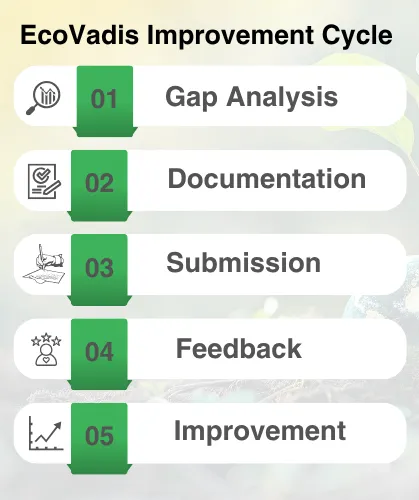
9. Focus on Continuous Improvement (Not One-Time Submission)
EcoVadis is not a one-time exercise.
High-performing companies:
- Track progress quarterly
- Update documents regularly
- Improve based on feedback
Ready to improve your EcoVadis score? Let’s get started.
EcoVadis Improvement Cycle:
10. Learn from Real Case Patterns (Not Just Guidelines)
Mini Case Insight
A mid-sized manufacturing firm struggled with a low EcoVadis rating despite having strong operational practices.
What changed:
- Structured documentation
- Clear ESG data tracking
- Basic supplier engagement
Result: Significant score improvement within one assessment cycle—without major capital investment.
Key Takeaway: Improving EcoVadis score is often about clarity and structure, not scale.
Final Thoughts: What Actually Moves the Score
To truly improve EcoVadis score, focus on this principle:
“Clarity, consistency, and credible evidence outperform complexity.”
Most companies don’t fail because they lack ESG initiatives—they fail because they cannot prove them effectively.
Companies don’t lose points because they lack ESG practices—they lose points because they fail to demonstrate them effectively.
Ready to align your sustainability strategy?
Talk to Growlity about building your ESG reporting strategy.