Insights
Ever thought about how far we should track a product’s impact, just until it leaves the factory, or all the way to recycling and reuse?
That’s where system boundaries in EPDs (Environmental Product Declarations) come in. A Cradle-to-Gate boundary looks at everything from raw material extraction to the point a product leaves the factory. It gives a clear picture of production impacts but stops short of showing what happens after. On the other hand, Module D goes further. It includes potential benefits at the end of a product’s life, like recycling, reuse, or energy recovery, making it especially valuable in industries focused on the circular economy, such as construction and renewable energy.
Understanding the difference between these two approaches isn’t just about technical details. It’s about transparency, credibility, and helping decision-makers choose more sustainable options. In this blog, we’ll break down Cradle-to-Gate and Module D in simple terms, compare their strengths and limits, and share why choosing the right boundary strategy can make a big difference for companies and the planet.
Understanding System Boundaries in EPDs
When creating an Environmental Product Declaration (EPD), one of the most important decisions is defining the system boundary. This boundary sets the limits of what processes and life cycle stages are included in the assessment. Without clear boundaries, comparing EPDs or understanding their results becomes difficult.
What Are System Boundaries?
In Life Cycle Assessment (LCA), system boundaries describe which parts of a product’s life cycle are included in the study. For example, do we only account for raw material extraction and manufacturing, or do we also consider use, recycling, and disposal? Standards like ISO 14025 and EN 15804 guide this process to ensure consistency. These frameworks make sure EPDs are transparent and comparable across industries.
Types of System Boundaries in EPDs
- Cradle-to-Gate: Includes impacts from raw material extraction up to the factory gate. Often used when products are sold as components for further use.
- Cradle-to-Grave: Extends the analysis to the entire life cycle, from production to disposal. Provides a complete environmental footprint.
- Cradle-to-Cradle: Focuses on circularity, where end-of-life materials are reused in new products, minimizing waste.
- Module D (Beyond the System Boundary): Captures potential benefits outside the main product life cycle, such as recycling or energy recovery. This is especially relevant in sectors like construction and renewable energy. In EPDs according to EN 15804, the output of valuable materials or energy to subsequent life cycles, i.e., these recyclates, is addressed in Module D.
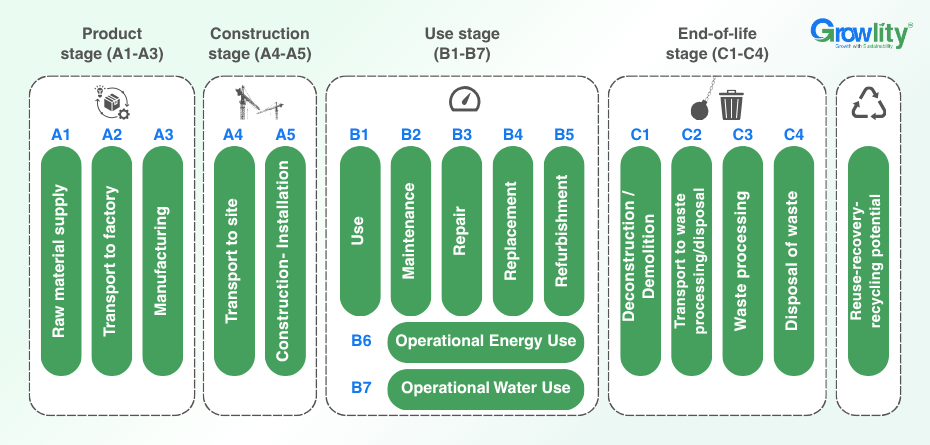
Cradle-to-Gate in EPDs
Cradle-to-Gate is one of the most widely used system boundaries in Environmental Product Declarations (EPDs). It measures a product’s environmental impact from the extraction of raw materials through the manufacturing process, up until the product leaves the factory gate. This approach gives a focused look at production impacts but does not include what happens after the product is used or disposed of.
What It Covers
Cradle-to-Gate covers all processes from resource extraction, material processing, and manufacturing, right up to when the product is ready for shipping. It excludes the use phase, maintenance, recycling, and end-of-life treatment. For industries selling intermediate products, like steel, cement, or packaging, this boundary is often the most relevant.
Why Companies Choose Cradle-to-Gate
Many companies start with Cradle-to-Gate because it is simpler and less data-heavy than a full life cycle assessment. It allows faster publication of EPDs and is particularly useful in complex global supply chains where tracking downstream impacts is difficult. This boundary also provides manufacturers with a verified footprint that can still meet customer and certification needs at an early stage.
Limitations of Cradle-to-Gate
The main drawback is that it only shows part of the picture. Without including use, disposal, or recycling, decision-makers like architects, builders, or policymakers may not get a full understanding of a product’s environmental footprint. As a result, Cradle-to-Gate EPDs are sometimes seen as less comprehensive compared to boundaries that extend further, such as Cradle-to-Grave or Module D.
Module D in EPDs
Module D is a unique part of Environmental Product Declarations (EPDs) because it goes beyond the system boundary. Unlike Cradle-to-Gate or Cradle-to-Grave, which focus only on the direct life cycle of a product, Module D accounts for what happens after the product’s end-of-life. It highlights the benefits of recycling, reuse, or energy recovery, showing how materials can reduce future environmental burdens.
What Module D Adds
Module D captures “avoided impacts” by looking at how products contribute to the circular economy once they are dismantled, recycled, or reused. For example, when steel from a demolished building is recycled into new products, the environmental benefits of avoiding virgin steel production are reported here. This helps stakeholders understand long-term sustainability benefits.
Importance of Module D
Including Module D makes EPDs more comprehensive and future-oriented. It is especially critical for construction materials such as steel, concrete, glass, and solar panels, where recycling potential is high. By showing these additional benefits, Module D supports circular economy goals and gives architects, engineers, and policymakers better insights for sustainable design and procurement.
Challenges with Module D
Despite its value, Module D comes with challenges. It often relies on assumptions about future recycling technologies, rates, and regional practices. Since these can vary widely, results may carry uncertainties. Different countries may interpret Module D differently, which can make comparisons difficult across markets. Still, it remains a powerful tool for promoting material efficiency and circularity.
Comparing Cradle-to-Gate and Module D
Cradle-to-Gate and Module D represent two very different approaches in Environmental Product Declarations (EPDs). While both help quantify a product’s environmental footprint, they serve different purposes and audiences. Understanding how they differ is key to interpreting EPDs correctly and making informed sustainability decisions
Key Differences
The main difference lies in coverage. Cradle-to-Gate only considers impacts up to the factory gate, offering a partial view of the life cycle. Module D, however, extends “beyond the system boundary” by including avoided impacts from recycling, reuse, or energy recovery at end-of-life.
Another distinction is data requirements. Cradle-to-Gate needs less data, making it quicker and easier to publish, while Module D demands detailed assumptions about future recycling and regional practices, which increases complexity.
For stakeholders, Cradle-to-Gate is useful for manufacturers starting out with EPDs, whereas Module D gives buyers and policymakers a clearer picture of long-term sustainability benefits.
Which One Matters for Decision-Makers?
For buyers like architects, construction firms, and developers, Module D is often more valuable because it shows the circular economy potential of materials. Policymakers also increasingly encourage or mandate Module D to align with climate goals. On the other hand, many manufacturers begin with Cradle-to-Gate for speed and practicality, especially in industries with complex supply chains.
In practice, both approaches are important, but Module D is steadily becoming the benchmark for future-ready, transparent EPDs.
Case Studies from Leading EPDs
Real-world examples help to show how different system boundaries are applied in practice. Let’s look at two industries, construction and renewable energy, where the choice between Cradle-to-Gate and Module D has a big impact on how EPDs are interpreted.
Construction Sector Example
Take the case of 7 Steel Service Norway, which published an EPD for steel reinforcement products used in concrete. The declared boundary is “Cradle to gate with modules C1–C4, Module D and options.” This means the EPD doesn’t stop at production but also includes end-of-life scenarios and Module D benefits. For steel, this is critical because recycling at demolition offers significant environmental credits. By reporting Module D, the EPD highlights the avoided impacts of producing virgin steel, an important signal for circular construction practices. Architects, contractors, and regulators can use this data to make more informed material choices.
Renewable Energy Example
Another example is 3S Swiss Solar Solutions AG, which developed an EPD for its Solar Roof system (TeraSlate Black Glass-BIPV). The system boundary is “Cradle to grave and Module D (A + B + C + D).” This goes beyond production and use, showing what happens when solar panels reach their end-of-life. By including Module D, the EPD demonstrates potential material recovery and energy benefits from recycling PV modules. For the renewable energy sector, where recyclability and circularity are increasingly important, this transparency builds trust and strengthens the case for sustainable solar solutions.
Global Standards and Policies Driving Module D
The adoption of Module D in Environmental Product Declarations (EPDs) is not just a technical choice, it is shaped by global standards and policies. Regulations and frameworks are pushing industries to go beyond production impacts and show the circular economy benefits of recycling and reuse.
EN 15804 and European Regulations
In Europe, the EN 15804 standard has been a game-changer. It requires EPDs in the construction sector to include Module D, ensuring that benefits from recycling, reuse, or energy recovery are accounted for. This aligns with the EU’s broader circular economy goals, where materials are kept in use for as long as possible. For industries like steel, concrete, and glass, including Module D is now a standard practice. European regulators and green building certifications also rely on this transparency, making Module D reporting a key part of sustainable construction.
US and International Practices
Outside Europe, the picture is different. In the United States and many international markets, EPDs still mostly follow the Cradle-to-Gate approach. This reflects the need for simpler, faster reporting, especially where regulatory pressure is lighter. However, there is a growing shift toward full life cycle reporting. Green building programs like LEED and policy developments in Canada, Australia, and parts of Asia are encouraging more comprehensive boundaries. Over time, Module D is expected to gain traction globally as industries and policymakers demand greater transparency about end-of-life impacts and recycling potential.
Choosing the Right System Boundary for Your EPD
Selecting the right system boundary is one of the most strategic steps in developing an Environmental Product Declaration (EPD). It determines not only what impacts are measured but also how the results will be perceived by customers, regulators, and certification bodies. The choice often depends on a balance between technical feasibility and market expectations.
Factors to Consider
The industry sector plays a major role. For example, construction products like steel, concrete, or glass benefit from Module D reporting because recycling potential is high. In contrast, sectors with shorter product lifespans may find Cradle-to-Gate sufficient for early disclosures.
The target audience also matters. Buyers such as architects or developers prefer full life cycle data to compare materials fairly. Regulators and certifiers (e.g., LEED, BREEAM) increasingly look for transparency that extends beyond production.
Finally, data availability and verification cost are practical constraints. Cradle-to-Gate requires less data and is faster to publish, while Module D demands detailed assumptions about recycling and disposal scenarios, which can raise costs and complexity.
Future Outlook
The trend is clear, EPDs are moving toward greater transparency. Policymakers and markets are pushing for Module D and full life cycle reporting to capture circular economy benefits. Over time, this will become the expectation rather than the exception, making early adoption a competitive advantage for manufacturers.
Conclusion
Choosing the right system boundary for your EPD isn’t just a technical decision, it’s a strategic one. Whether you go with Cradle-to-Gate for a simpler, faster disclosure or include Module D for a more complete picture of circularity, the boundary you set will shape how your product is understood in the market.
As industries move toward greater transparency and accountability, we’re seeing a clear shift toward full life cycle reporting. Regulators, certifiers, and even buyers are increasingly asking for Module D because it highlights recycling, reuse, and long-term environmental benefits. While this may involve more data collection and higher verification costs, it also builds trust and strengthens your position in sustainability-driven markets.
The key takeaway? Think about your industry sector, audience expectations, and future requirements when deciding on the scope of your EPD. Making the right choice now can save time, build credibility, and give you a competitive edge as reporting standards continue to evolve.
At Growlity, we work closely with companies to navigate these decisions, helping them select the appropriate system boundaries and ensure accurate, transparent reporting. Our approach focuses on clarity and practical guidance, supporting organizations in understanding the environmental impacts of their products without adding unnecessary complexity.
On Environmental Product Declarations
What is the difference between Cradle-to-Gate and Module D?
Why do most companies start with Cradle-to-Gate EPDs?
Is Module D mandatory in all EPDs?
Which industries benefit most from Module D reporting?
How do Cradle-to-Gate and Module D affect green certifications (LEED, BREEAM)?



Latest Blog Posts