Insights
CDP 2026 Timeline: Key Dates, Deadlines, and Strategic Actions Every Company Should Know
CDP 2026 Timeline: Why This Year’s Disclosure Cycle Matters More Than Ever
The CDP 2026 timeline is more than a schedule of reporting deadlines. It represents one of the most important environmental disclosure cycles organizations have faced in recent years.
Investors, customers, regulators, lenders, and procurement teams increasingly rely on CDP disclosures to evaluate climate resilience, environmental performance, and long-term business preparedness. Companies that approach CDP as a compliance exercise often struggle to generate value from the process. Those that align internal strategy with the reporting timeline gain a competitive advantage.
As environmental disclosure expectations continue to evolve, organizations need a clear understanding of the CDP 2026 timeline to ensure timely submission, stronger data quality, and improved scoring outcomes.
This guide provides the key dates, strategic actions, preparation milestones, and expert recommendations companies should follow throughout the disclosure cycle.
What Is CDP and Why Does It Matter?
CDP is the world’s leading environmental disclosure platform, enabling organizations to report data related to climate change, water security, forests, and broader environmental impacts.
Today, thousands of companies disclose through CDP because investors and supply chain partners increasingly use CDP data to assess risk, resilience, and sustainability performance. According to CDP, more than 23,000 organizations disclosed environmental data in the previous reporting cycle.
Organizations that participate effectively often benefit from:
- Enhanced investor confidence
- Stronger supply chain relationships
- Better environmental risk management
- Improved ESG ratings
- Greater transparency and accountability
CDP 2026 Timeline: Key Dates and Milestones
June 2026: Disclosure Cycle Opens
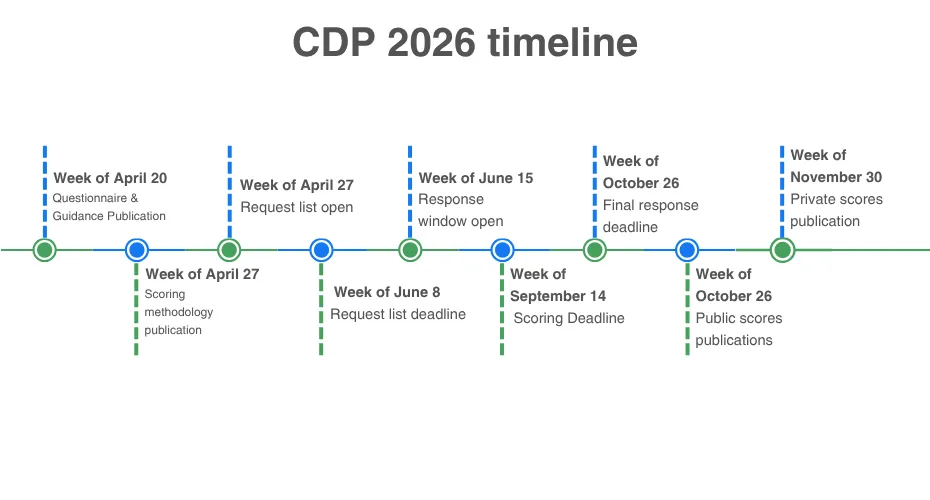
CDP’s 2026 disclosure cycle officially opens in June, with questionnaires, guidance documents, and scoring methodologies becoming available through the CDP Portal. New organizations wishing to self-disclose can also begin registration during this period.
Recommended Actions:
- Review questionnaire updates
- Confirm reporting boundaries
- Establish internal reporting teams
- Engage consultants and assurance providers
- Begin data collection validation
June–July 2026: Preparation and Gap Assessment
This is the most critical phase of the reporting process.
Organizations should conduct:
- Climate data reviews
- GHG inventory verification
- Governance assessments
- Risk and opportunity analyses
- Target validation exercises
Companies that start early typically have significantly fewer submission challenges later in the cycle.
August–September 2026: Questionnaire Completion
During this stage, sustainability teams should focus on:
- Finalizing responses
- Cross-functional reviews
- Leadership approvals
- Evidence documentation
- Data consistency checks
Many organizations underestimate the time required for internal reviews. Starting early can significantly reduce last-minute errors.
October 2026: Final Submission Deadline
CDP indicates that the disclosure window closes in October, with the final response deadline scheduled during the week commencing October 26, 2026. Once the questionnaire closes, organizations can no longer edit their submissions.
Before Submission:
- Verify emissions calculations
- Validate environmental targets
- Review governance disclosures
- Check supporting evidence
- Conduct executive sign-off
Major Changes Organizations Should Watch in the CDP 2026 Timeline
The 2026 disclosure cycle introduces several notable enhancements aimed at improving usability, alignment, and data quality.
Key developments include:
Expanded Nature Coverage
CDP is expanding environmental coverage to include ocean-related disclosure areas while enhancing forest and water-related reporting requirements.
Stronger Framework Alignment
The questionnaire continues to deepen alignment with:
This reduces reporting duplication and improves interoperability across sustainability frameworks.
Enhanced Technology and Data Management
Organizations will benefit from:
- Improved navigation
- Better guidance
- Expanded data ingestion capabilities
- Improved accessibility features
These updates are intended to simplify disclosure while increasing data quality.
A Practical CDP 2026 Timeline Preparation Roadmap
6–9 Months Before Submission
Focus on:
- Governance structure reviews
- Materiality assessments
- Climate risk evaluations
- Data management improvements
3–6 Months Before Submission
Focus on:
- Emissions calculations
- Target validation
- Internal stakeholder engagement
- Supply chain data collection
1–3 Months Before Submission
Focus on:
- Draft responses
- Executive review
- Data verification
- Assurance preparation
Final Month
Focus on:
- Quality checks
- Submission testing
- Final approvals
- Portal validation
Case Study: How Early Preparation Improves CDP Performance
A multinational technology company began its reporting preparation eight months before the disclosure window opened.
Instead of waiting for the questionnaire release, the company focused on:
- Strengthening emissions data management
- Aligning climate targets with science-based pathways
- Improving governance disclosures
- Conducting internal mock reviews
The result was faster submission, fewer data gaps, and a stronger disclosure outcome compared to previous years.
The lesson is simple: organizations that prepare for the CDP 2026 timeline before the reporting window opens consistently perform better than those that wait.
Common Mistakes Companies Make During the CDP 2026 Timeline
Many organizations lose valuable scoring opportunities because they:
- Start data collection too late
- Lack executive engagement
- Fail to document evidence
- Use inconsistent emissions methodologies
- Ignore questionnaire updates
- Treat CDP as a reporting exercise instead of a strategic process
Avoiding these mistakes can significantly improve disclosure quality.
Why the CDP 2026 Timeline Matters for Investors and Customers
Environmental disclosure is increasingly linked to:
- Capital allocation decisions
- Supplier evaluations
- Sustainable procurement programs
- Climate transition planning
- Corporate resilience assessments
Companies that effectively navigate the CDP 2026 timeline position themselves as credible partners in an increasingly transparent business environment.
Looking Beyond the Deadline
The most successful organizations do not view CDP as an annual reporting event.
Instead, they use the disclosure process to:
- Improve sustainability strategy
- Strengthen climate governance
- Enhance stakeholder trust
- Identify operational risks
- Unlock long-term value creation
The CDP 2026 timeline should therefore be viewed as a strategic planning framework rather than simply a reporting calendar.
Resources
Official CDP Resources
Ready for CDP 2026?
Whether your organization is preparing its first disclosure or aiming to improve its score, starting early can make the difference between a reactive submission and a strategic disclosure.
Need support with CDP reporting, gap assessment, emissions accounting, climate strategy, or sustainability disclosures? Contact our ESG experts to build a disclosure roadmap aligned with your business goals.
CDP 2026 Timeline: Key Dates, Milestones & Actions
| Timeline Phase | Expected Period* | What Happens | Recommended Actions |
| Preparation & Readiness | January – May 2026 | Organizations prepare for the upcoming disclosure cycle and review reporting requirements. | Conduct gap assessment, update GHG inventory, review climate targets, align governance structures, and assign reporting responsibilities. |
| Disclosure Cycle Opens | June 2026 | CDP opens the disclosure cycle and releases questionnaires, guidance documents, and reporting updates. | Review questionnaire changes, understand scoring methodology updates, and create a detailed disclosure roadmap. |
| Data Collection & Validation | June – July 2026 | Companies gather environmental data across operations, facilities, and supply chains. | Verify emissions data, engage stakeholders, collect supporting evidence, and address reporting gaps. |
| Questionnaire Completion | July – September 2026 | Teams prepare responses and compile supporting documentation. | Draft responses, conduct internal reviews, validate calculations, and secure leadership approvals. |
| Final Submission Window | October 2026 | Organizations submit completed CDP disclosures. | Perform quality assurance checks, finalize evidence, complete executive sign-off, and submit before the deadline. |
| Scoring & Evaluation | Post Submission | CDP reviews disclosures and applies scoring methodology. | Analyze submitted responses, identify improvement areas, and prepare for future reporting cycles. |
| Continuous Improvement | Ongoing | Organizations use disclosure insights to strengthen sustainability performance. | Enhance climate strategy, improve data systems, strengthen governance, and track progress against targets. |
*Note: Organizations should always refer to official CDP communications for the latest confirmed dates and updates.
Quick Snapshot: CDP 2026 Timeline at a Glance
| Month | Priority Focus |
| January–March | Gap assessment and strategy alignment |
| April–May | Data readiness and stakeholder engagement |
| June | Disclosure cycle opens |
| July–August | Data collection and response drafting |
| September | Internal review and leadership approval |
| October | Final submission |
| November onwards | Score analysis and improvement planning |
Key Takeaway
The organizations that achieve the strongest CDP outcomes are rarely the ones that work hardest in October they are the ones that start preparing in January.
When does the CDP 2026 disclosure cycle open?
What is the final deadline for CDP 2026 submissions?
What are the major changes in the CDP 2026 questionnaire?
Why is CDP reporting important?
How early should companies begin preparing?



Latest Blog Posts